Dr. Dimple Doshi (MBBS, MD, DGO)
Gynecologist & Laparoscopic Surgeon
27+ years’ experience
20,000+ surgeries completed
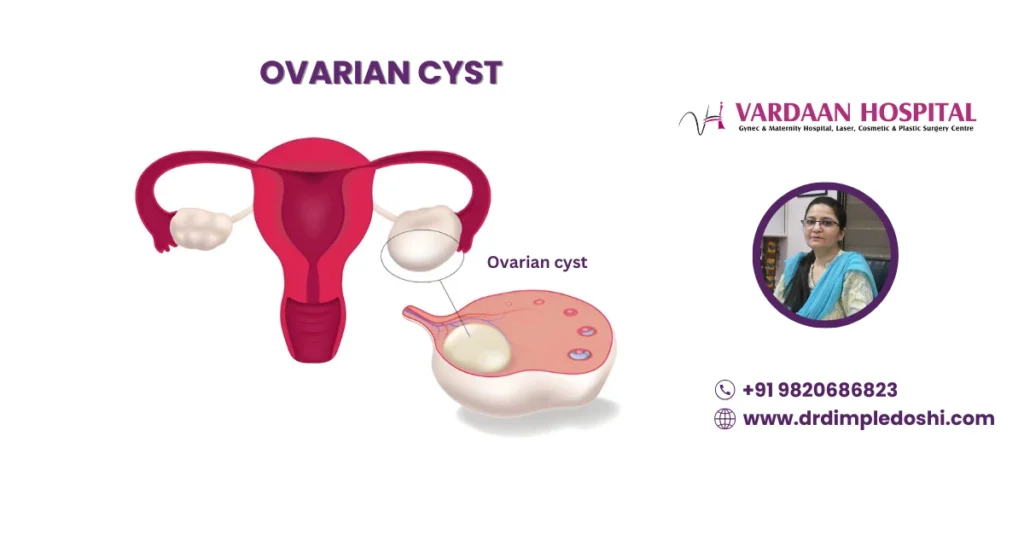
An ovarian cyst is a fluid-filled sac that forms on or inside an ovary; most are harmless, cause no symptoms, and clear up on their own.
Ovarian cysts are a common part of women’s reproductive health. Many form as a normal part of the monthly cycle and disappear without any treatment. Others are found by chance on a scan done for another reason. Most cause no trouble at all — but some grow, cause symptoms, or need a closer look.
Ovarian cysts are very common — an estimated 8–18% of women develop one in their lifetime, and many never notice them.
Finding one on a scan is usually not a cause for alarm — most are small, harmless and temporary. What matters is identifying the type and whether it needs monitoring or treatment.
Ovarian cysts include functional, haemorrhagic, dermoid, endometrioma (chocolate) and cystadenoma; most are benign, a few need closer review.
| Type | In brief |
|---|---|
| Functional (follicular / corpus luteum) | Form with normal ovulation; usually resolve on their own |
| Haemorrhagic | A functional cyst with some bleeding inside |
| Dermoid | Contains various tissue types; usually benign |
| Endometrioma (chocolate cyst) | Ovarian endometriosis |
| Cystadenoma | Grows from the ovary surface; usually benign |
| Paraovarian | Sits beside the ovary |
| Polycystic ovaries (PCOS) | Many small follicles; a hormonal pattern, not a single cyst |
| Borderline / malignant | Uncommon; borderline has low malignant potential, and a small number are cancerous |
Knowing the type guides everything that follows — most need only reassurance or monitoring.
An adnexal mass is any growth near the uterus — in the ovary, fallopian tube or nearby tissue — so an ovarian cyst is one common type of adnexal mass.
“Adnexal mass” (sometimes called an adnexal tumour) is an umbrella term. The adnexa are the structures beside the uterus — ovaries, fallopian tubes and supporting tissue — so a mass there can come from more than just the ovary. An ovarian cyst is the most common example; others include a fibroid extending towards the adnexa, an infection-related mass, or an ectopic pregnancy. The first job is always to work out what kind of mass it is.
Ovarian cysts often form with normal ovulation; other adnexal masses arise from endometriosis, fibroids, infection, ectopic pregnancy or cancer.
Common causes and contributors:
Because the causes vary so widely, evaluation is tailored to your age, symptoms and scan findings.
Ovarian cysts often cause no symptoms; larger ones may bring pelvic pain, bloating, irregular periods, or pressure on the bladder or bowel.
Possible symptoms:
Living with unexplained pelvic pain can be wearing — you deserve a clear answer, and a scan usually provides one quickly.
Most ovarian cysts are harmless, but some can rupture, bleed, or cause the ovary to twist (torsion) — a sudden, severe pain that needs emergency care.
Uncommon but important complications:
These are the reasons a persistent or growing cyst is reviewed rather than ignored — see the emergency signs above.
Ovarian cysts and adnexal masses are diagnosed with a pelvic ultrasound, sometimes MRI, and blood tests when needed to check the cyst’s nature.
Typical evaluation:
The aim is to tell a simple, benign cyst apart from one that needs treatment or specialist input.
Ovarian cyst treatment ranges from watchful monitoring to hormonal medicines or fertility-preserving laparoscopic surgery, based on size and symptoms.
Care follows a conservative-first path:
| Option | What it involves | Suited to |
|---|---|---|
| Watchful monitoring | Re-scanning over weeks/months | Small, simple, symptom-free cysts |
| Medical management | Hormonal therapy, GnRH analogues, metformin (PCOS), pain relief | Symptom control or hormone-related cysts |
| Laparoscopic surgery | Keyhole cyst removal (cystectomy), preserving healthy ovary | Growing, symptomatic, or persistent cysts |
| Open / oncological surgery | Larger-incision or staged surgery with specialist input | Very large masses, or borderline/malignant cases |
Surgery is usually considered when a cyst is large or growing, causes severe pain or pressure, raises the risk of torsion, is a dermoid or endometrioma, or has features that need removal. The right option depends on the cyst type, size, your age and fertility plans — outcomes vary by individual.
A laparoscopic ovarian cystectomy removes the cyst through small keyhole cuts while preserving the ovary, usually completed in under an hour.
What the procedure involves:
The key aim is to preserve the ovary — it’s kept in most cases, which helps protect fertility, especially when the ovary itself isn’t removed. Bigger, complex or possibly cancerous masses may instead need open surgery with specialist input. At Vardaan Hospital, advanced 3D laparoscopy supports precise, ovary-sparing removal.
Most ovarian cysts and adnexal masses are benign, especially in younger women; the chance of cancer rises with age, so they are assessed carefully.
The reassuring context: the large majority of ovarian cysts and adnexal masses — particularly in reproductive-age women — are benign. The likelihood that a mass is cancerous increases with age, so masses found after menopause are assessed more carefully and may be referred for specialist (oncology) input when the features suggest it. A cyst is not the same as cancer — careful assessment, not worry, is the right first step.
Recovery after laparoscopic ovarian cystectomy is usually quick — walking within hours, light activity in 2–3 days, and normal routine by about 1–2 weeks.
A general guide after keyhole surgery (open surgery is slower):
| Stage | What to expect |
|---|---|
| 4–6 hours | Gentle walking begins |
| 2–3 days | Light activities |
| 7–10 days | Back to normal daily activities |
| ~2 weeks | Avoid heavy lifting until then |
| 4–6 weeks | Periods usually settle back to their pattern |
Small keyhole scars fade over time. Feeling well externally doesn’t always mean healing is fully complete, so follow your surgeon’s advice on lifting and activity.
Most ovarian cysts don’t affect fertility; some, like endometriomas or PCOS, can, and surgery aims to treat the cyst while protecting the ovary.
Key points:
If you’re planning pregnancy, your treatment plan is tailored to protect your fertility.
Laparoscopic ovarian cystectomy in Mumbai ranges roughly from ₹50,000 to ₹2,00,000 by room category; final cost is set after consultation.
Approximate packages at Vardaan Hospital:
| Room category | Approximate cost (₹) |
|---|---|
| General ward | ~50,000 |
| Semi-special room | ~68,000 – 75,000 |
| Deluxe room | ~1,20,000 |
| Super deluxe room | ~1,50,000 |
| Suite room | ~2,00,000 |
The exact figure depends on the cyst type and size, surgical complexity, room category and any additional procedure. At Vardaan Hospital, eligible patients may access cashless and reimbursement assistance, subject to insurance approval. Cost is a range and is finalised after consultation; outcomes vary by individual.
You can’t always prevent ovarian cysts, but regular check-ups, managing PCOS and hormones, and early review of symptoms help catch them sooner.
Practical steps:
These can’t rule out cysts entirely, but they help catch any change early, when it’s simplest to manage.
Dr. Dimple Doshi offers accurate diagnosis and fertility-preserving ovarian cyst and adnexal mass care using advanced 3D laparoscopy at Vardaan Hospital, Goregaon West, Mumbai.
Full credentials are viewable on the About page.
Ans. Most ovarian cysts are harmless and clear on their own. A few can cause complications like rupture or ovarian torsion, and a small number need closer review. Sudden, severe pelvic pain should be checked urgently.
Ans. No. An adnexal mass is any growth near the uterus, and most are benign — especially in younger women. The chance of cancer rises with age, so masses are assessed carefully with a scan and, if needed, further tests.
Ans. No. Many small, simple, symptom-free cysts just need monitoring with repeat scans. Surgery is considered when a cyst grows, causes symptoms, or has features that need removal.
Ans. Most simple cysts don’t affect fertility. Some, such as endometriomas or PCOS, can, and treatment is planned carefully to protect the ovary and your fertility.
Ans. Not always. Many cysts are simply monitored and go away on their own. Surgery is advised only if the cyst is large, growing, causing symptoms, or has features that need removal.
Ans. Many women stay in hospital about a day and return to light routine within 1–2 weeks after keyhole surgery. Heavy lifting and strenuous activity are avoided for a few weeks.
Ans. Some can, especially functional cysts or with conditions like PCOS or endometriosis. Your doctor may suggest monitoring or ongoing management to reduce recurrence.
Ans. See a gynecologist for persistent pelvic pain, bloating, cycle changes or a cyst found on a scan. Seek emergency care for sudden severe pain with nausea, fever, or fainting.
Book an Ovarian Cyst Consultation with Dr. Dimple Doshi
If a scan has shown an ovarian cyst or adnexal mass, or you have pelvic pain or bloating, a consultation can clarify the type and whether monitoring, medicines or surgery is right for you.